2023년 4월 12일 수요일

이과 필수과목 폐지 압박에… 대학들 “미적분 모르고 공대 가란 말

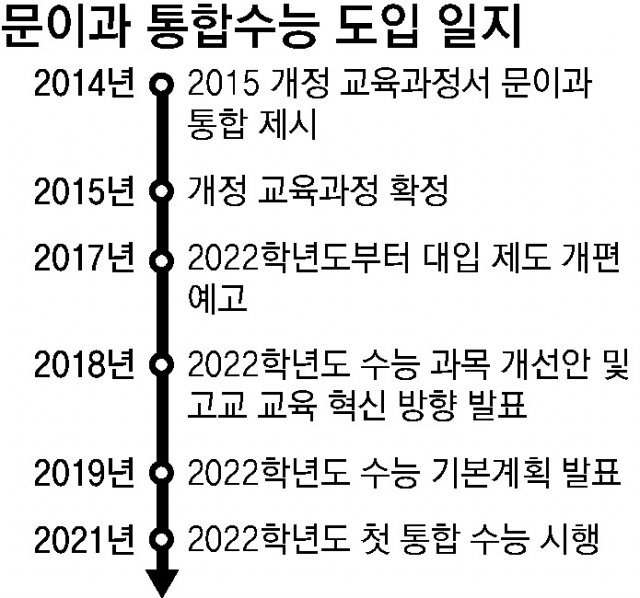
 2025학년도 대학 입학 전형 시행계획이 이달 말 발표될 예정인 가운데 문과·이과 학생 선발을 둘러싼 대학과 교육 당국의 갈등이 심화하고 있다. 정부는 ‘문·이과 통합’이라는 장기 계획에 맞춰 고교 문·이과 통합, 통합 대학수학능력시험(수능)을 단행해 왔다. 융합형, 창조형 인재를 배출해야 할 미래에 과거의 문·이과 ‘칸막이식’ 교육은 더 이상 유효하지 않다는 문제의식에서다. 당국은 이 장벽을 더 허물려는 기조다.


반면 대학가의 분위기는 심상치 않다. 고교 교육과정과 수능은 정부가 바꿨지만, 대입에서까지 이 틀이 흔들리는 것은 원치 않는 분위기다. 특히 그간 수학, 과학 실력이 우수한 이과 상위권 학생들을 선호해 온 주요대 의대, 이공계열, 자연계열 학과들 사이에서는 우려와 불만이 커지고 있다. 교육 당국과 대학 사이에 무슨 일이 벌어지고 있는 것일까.》


● “필수 과목 없애라” 대학에 요구


지난달 10일 경기 광주시 모처에서는 한국대학교육협의회(대교협)가 수도권 대학 주요 입학처 관계자들을 모아 세미나를 열었다. 이 자리에서 대교협은 대학들에 수능 선택과목을 둘러싼 요구 사항을 밝힌 것으로 알려졌다. 현재 주요대 의대, 이공계열, 자연계열 학과들이 유지하고 있는 ‘필수 선택과목’을 폐지하고 문과생들이 쉽게 이들 학과에 진학할 수 있도록 해달라는 요구였다.

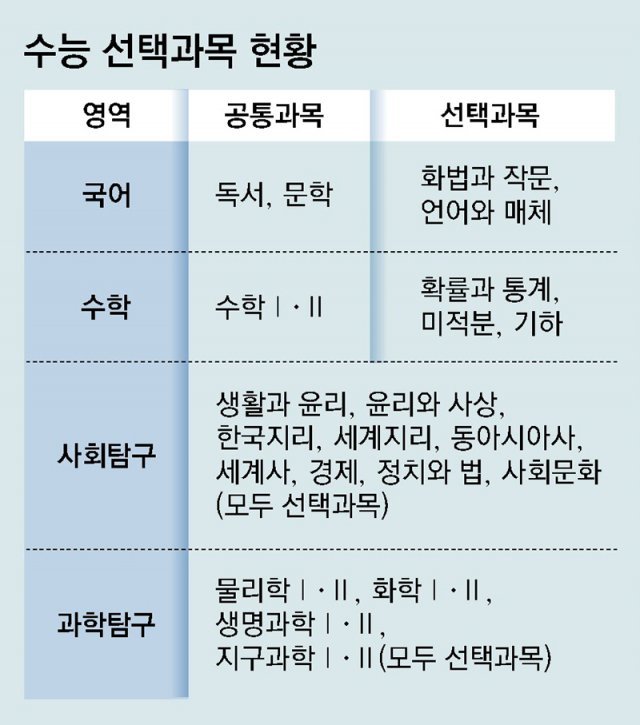
2022학년도부터 시작된 통합 수능 체제에서는 수험생 누구나 치러야 하는 ‘공통과목’과 골라서 치르는 ‘선택과목’이 있다. 가령 수학은 총 30문항 중 공통과목에서 22문항이 출제되고, 나머지 선택과목인 ‘확률과 통계(확통)’, ‘미분과 적분(미적분)’, ‘기하’에서 8문항이 출제된다. 국어는 ‘언어와 매체’, ‘화법과 작문’이 선택과목이다. 과학탐구에서는 물리Ⅰ·Ⅱ, 화학Ⅰ·Ⅱ, 생명과학Ⅰ·Ⅱ, 지구과학Ⅰ·Ⅱ가 있다. 고교 문·이과 학생 모두 이 중 자신이 원하는 과목을 선택해 수능을 치르고 그 성적으로 대학에 지원한다.

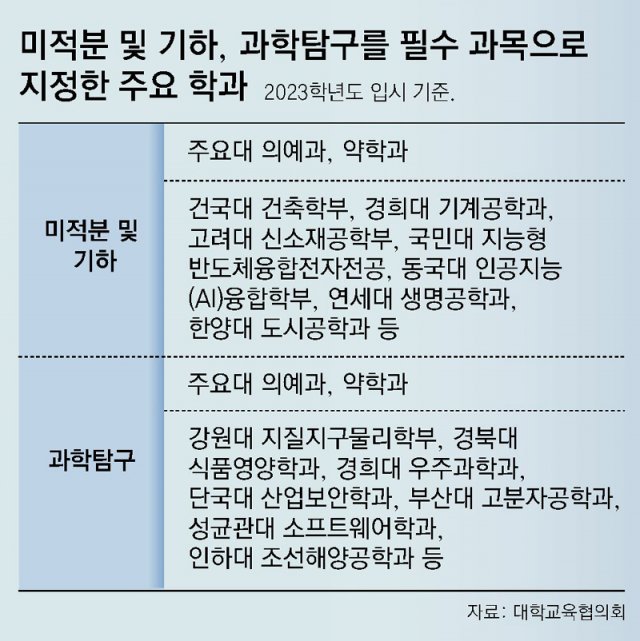
문제는 각 대학, 그리고 학과들이 내세우는 조건이다. 통합 수능 시행 이후 대부분 대학의 경제 및 경영학과, 사회학과, 국문과, 영문과 등 인문계열 학과들은 수험생이 치러야 할 과목에 제한을 두지 않았다. 반면 의학·이공·자연계열 학과들은 다소 다르다. 의대, 치의대, 컴퓨터공학과, 화학공학과, 수학과, 물리학과, 전기전자공학과 같은 곳들이다. 이들은 대부분 ‘필수 선택과목’을 대학이 미리 지정해 뒀다. 학교나 학과에 따라 차이는 있겠지만 대부분 수학은 미적분이나 기하, 탐구는 과탐을 지정했다. 이과생들이 공부하는 과목들이다.

여기서 문제가 발생한다. 이과생은 인문계열 학과에 진학할 때 장벽이 없는데, 문과생이 의학·이공·자연계열 학과에 가려면 필수 선택과목을 응시해야 한다. 그러지 않으면 지원서를 낼 수도 없다.

가령, 수학 영역만 봐도 문·이과생들이 각각 주로 선택하는 확통, 그리고 미적분·기하는 서로 난도나 학습량이 매우 차이가 난다. 학원가에서는 “미적분 만점을 받기 위한 학습량은 확통의 5∼10배”라고 입을 모은다. 미적분, 기하에는 최상위권 학생들을 분별하기 위한 일명 ‘킬러 문항’, 초고난도 문제도 2, 3문항씩 출제된다. 과탐 영역도 물리Ⅱ, 화학Ⅱ 등의 선택과목에는 대학 전공자들도 풀기 어려운 문제들이 종종 출제된다.
● 문·이과 통합에도… 입시 장벽 여전


2025년 고교학점제 도입이 예고된 가운데 각 대학은 수시모집 선발 과정에서도 이러한 구조를 유지하려고 시도하고 있다. 고교학점제란 고교생도 대학생처럼 본인이 원하는 과목을 골라서 수강하고 일정 학점을 채우는 것을 말한다.

지난달 23일 경희대, 고려대, 성균관대, 연세대, 중앙대 등 5개 대학 입학처는 ‘고등학생 교과 이수 과목의 대입전형 반영 방안 연구’ 보고서를 내놨다. 2025학년도 대입 전형 시행계획 제출 기한을 7일 앞둔 시점이었다. 이들 학교는 자연계열 14개 중 12개는 미적분을 고교에서 들어야 할 핵심 과목으로 제시했다. 또 물리학과는 물리Ⅰ·Ⅱ를 핵심 과목으로 지정했다. “우리 학교에 입학하려면 미적분을 배우고 오라”는 일종의 지침을 제시한 것이다.

이 때문에 교육부는 의학·이공·자연계열 학과들이 유지하고 있는 필수 과목을 ‘대학 재정지원 사업’을 통해 허물려 한다. 대교협은 교육부로부터 ‘고교교육기여대학 지원 사업’을 위탁받아 실시하고 있는데, 올해는 총 91개 대학에 575억 원이 지원된다. 교육부는 사업비의 책정에 각 대학이 문·이과 통합 교육, 통합 수능의 취지를 얼마나 학생 선발에 반영했는지 고려하겠다는 입장이다.

지난해 국내 4년제 대학의 연평균 등록금은 676만3100원이다. 가령 정부 지원금 10억 원이면 재학생 147명의 등록금과 맞먹는다. 재정이 어려운 지방대의 경우 지원금 10억 원을 포기하는 대신 기존의 입시 전형을 고수하기 위해서는 신입생을 무려 147명을 더 뽑아야 한다는 계산이 나온다. 이는 사실상 불가능하다. 서울의 한 상위권 사립대 입학처장은 “교육부의 눈 밖에 나는 순간 해당 사업뿐만 아니라 다른 모든 정부 재정지원 사업에서 불이익을 받을 것이라는 불안감이 늘 있다”고 말했다. 재정지원 사업에서 탈락한 대학에서 총장이 물러나는 일도 비일비재하다.
● 의학·이공·자연계열 “수업 부담 우려”


물론 필수 과목을 고수하는 의학·이공·자연계열 학과 입장에서도 할 말은 있다. 문·이과 통합 취지는 좋지만 대학에서의 연구, 수업, 장기적으로 인재 양성에 문제를 야기할 수 있다는 지적이다.

수도권의 한 이공계열 학과 교수는 “학부 교수 입장에서는 신입생이 이미 미적분을 알고 있다는 전제하에 1학년 수업을 하는데, 미적분도 모르는 문과생이 여럿 입학해 강의실에 앉아 있다면 수업을 할 수 없다”며 “문·이과 격차를 고려하면 감당하기 쉽지 않다”고 토로했다.

반면 선제적으로 문·이과 장벽을 허무는 대학도 일부 있다. 서강대는 내년 신입생(2024학년도)부터 자연계열의 수학, 탐구영역 필수 응시 과목을 전면 폐지한다. 중앙대도 내부적으로 이를 고려 중이다.

● “문과서도 의대 쏠림 나타날 수”


교육당국과 대학 간의 줄다리기와는 관계없이 교육계에서는 또 다른 부작용을 우려하는 목소리도 나온다. 융합 인재를 기르고 문·이과 장벽을 없애자는 정책 취지가 생각지도 못한 방향으로 이어질 수 있다는 지적이다.

대표적인 것 중 하나는, 현재 이과에서 문제가 되고 있는 ‘의대 쏠림’ 현상이 문과로까지 확장될 것이라는 우려다. 임성호 종로학원 대표는 “자연계열 필수 과목이 사라지면 장기적으로는 문과생마저 의대로 쏠리는 현상이 나타날 가능성도 배제할 수 없다”고 분석했다. 지금은 문과 최상위권 학생이 몰려 있는 외국어고, 국제고는 대부분 인문계열로 진학하지만, 필수 과목이 사라지면 이들이 인문계열 대신 사회적 지위나 향후 연봉 등을 고려해 의대, 약대, 수의대 등으로 몰릴 수 있다고 분석한다. 임 대표는 “파장이 중학교급까지 미치면, 중학교 상위권 학생들이 장기적으로 의대 진학을 위해 일부러 내신에서 유리한 문과로 진학한 뒤 통합 수능으로 의대에 지원하는 새로운 ‘의대 루트’가 열릴 수도 있다”고 경계했다. 커트라인이 높은 수도권 주요 의대까지는 아니더라도 지방대 의대는 충분히 가능성이 있다는 뜻이다.

donga.com

2023년 4월 8일 토요일

하버드가 밝히는 성공하는 자녀의 5가지 특성


 "우리 아이는 커서 어떤 사람이 될까요?"는 모든 부모가 궁금해하는 질문입니다.


하지만 궁금해하기만 할 것이 아니라, 자녀가 잠재력을 최대한 발휘하는 데 필요한 기술을 개발할 수 있도록 부모로서 도와줄 수 있는 부분은 많습니다.

하버드 대학 교수이면서 번창하는 아이들의 저자인 '미셀 보르바' 박사는 성공적인 자녀를 키운 70명의 부모를 분석했습니다. 그 결과, 그들은 자녀의 미래 성취에 기여한 다섯 가지 핵심 특성을 발견했습니다.

자녀가 성공할 가능성이 높은 다섯 가지 특성을 알아봅시다.

블로그 들어가기

2023년 4월 1일 토요일

'자연수 집합'과 '짝수 집합' 크기는 같다?...수학 바꾼 '무한'

 인류는 오랜 시간 수를 탐구해왔다. 그러다가 상상할 수조차 없이 큰 상태, 무한을 접하고 고민에 빠졌다. 시간이 흘러 어느새 무한이라는 단어가 우리의 일상에 들어왔지만, 우리는 무한을 제대로 알고 있을까. 수학자는 무한의 수학적 정의에 관해, 인문학자는 무한의 역사와 실재에 관한 철학적 사유에 대해 이야기해본다.


○ 첫 번째 질문. 인류는 무한을 어떻게 떠올리게 됐을까


Q(수학자). 무한을 단순히 큰 수라고 생각하는 분도 계실 텐데요. 사실은 어떤 정해진 큰 수를 넘어서 ‘영원히 끝나지 않는 상태’라는 어려운 개념이에요. 그럼 인류사에서 무한에 관심을 갖고 탐구하기 시작한 건 언제부터일까요.


A(인문학자). "유한한 삶을 사는 인간이 무한에 대해서 생각하기 시작했다는 것 자체가 흥미로운 일입니다. 인류는 무서운 자연재해를 겪고 신에 관한 생각을 가지면서부터 자연스럽게 무한한 존재에 관심을 가졌어요. 그러다 보니 무한에 관한 고민을 언제부터 시작했는지를 정확히 아는 건 어려운 일이지요. 무한을 수학적으로 연구한 고대 기록 가운데 흥미로운 것이 무엇이냐고 묻는다면, 고대 그리스 수학자 아르키메데스(기원전 3세기경)의 저서 <모래알을 세는 사람>을 이야기할 수 있어요. 


아르키메데스는 공간 차원의 무한을 고민하면서 이 책을 썼는데요. 책에는 ‘우리가 사는 우주 전체를 모래알로 채운다면 얼마나 많은 모래알이 필요할까’라는 굉장히 재미있는 상상이 적혀 있어요. 그런 면에서 이 책이 인류가 무한을 다루기 위한 예비적인 작업으로서 의미가 있다고 생각해요. 아르키메데스의 <포물선의 면적에 관하여>라는 책에는 시간 차원의 무한을 고민한 흔적이 있는데요. 책에서 포물선과 직선이 두 점에서 만나 만드는 활꼴의 넓이를 구하려고 합니다. 


먼저 활꼴에 내접하는 삼각형을 그리고, 삼각형을 빼고 남은 활꼴에 또 삼각형을 그리는 과정을 반복해 삼각형들의 넓이를 합하는 방법을 사용합니다. 이를 시간 차원의 무한이라고 말하는 이유는 삼각형을 내접시키는 작업을 끝도 없이 진행하기 때문입니다. 이 방법을 ‘소진법’이라고 하는데, 오늘날 무한히 수를 더하는 ‘무한급수’를 구하기위한 노력의 시초라고 할 수 있지요"


○ 두 번째 질문. 수학에선 무한을 어떻게 정의할까


Q(인문학자). 고대 그리스에서 무한으로 어떤 탐구를 했는지 짧게 살펴봤는데요. 오늘날 수학자는 무한을 어떻게 정의하나요.


A(수학자). "앞서 무한은 수의 개념이 아니라 영원히 끝이 안나는 상태에 가깝다고 했는데요. 아무리 큰 자연수가 있어도 그 수에 1을 더하면 새로운 자연수가 나타나잖아요. 그래서 가장 큰 자연수를 구하라는 질문에 대답할 수 없어요. 수학에서 이러한 부분을 엄밀하게 다루는 분야를 ‘집합론’이라고 합니다. 수학에서는 무한을 정의할 때 먼저 원소의 개수가 무한한 집합을 찾고, 그 집합의 크기를 무한이라고 이야기해요. 자연수 집합이 대표적이지요."


Q(인문학자).  그러니까 무한을 다루기 위해서 적절한 대상의 집합을 설정하고, 그 집합의 크기를 일종의 무한이라고 생각한 거네요. 그 말씀을 듣고 보니까 끝이 없는 무한을 크기로 표현한다는 게 너무 재미있는 생각 같아요. 그러면 더 큰 무한과 더 작은 무한으로 나눌 수도 있을까요.


A(수학자). "그렇죠. 그 부분이 무한을 이해하는 핵심이에요. 자연수 집합 안에 짝수 집합이 포함돼 있어요. 그러면 자연수 집합과 짝수 집합 중 어느 집합이 클까요? 대다수가 아무 의심 없이 자연수 집합이 더 크다고 생각할 거예요. 그런데 두 집합의 크기는 똑같아요. ‘한 집합이 다른 하나를 포함하고 있다’와 ‘한 집합이 다른 집합보다 크다’는 같은 문장이 아니에요. 


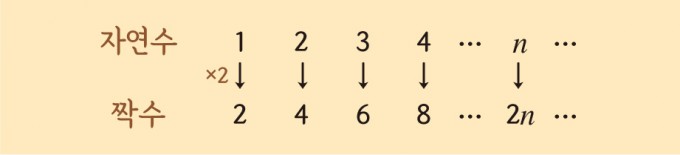
그렇다면 무한 집합은 어떻게 크기를 비교할까요? 수학자들은 어떤 집합과 다른 집합이 일대일대응이 된다면 이 두 집합의 크기가 같다는 개념을 내세워요. 자연수 집합과 짝수 집합을 한번 비교해볼게요. 자연수 집합에서 1, 2, 3, 4…에 2를 곱한 짝수를 대응하면 빠지는 숫자가 없이 모두 일대일대응이 돼요. 그렇기 때문에 두 집합의 크기가 같아요.


수학동아 DB
수학동아 DB

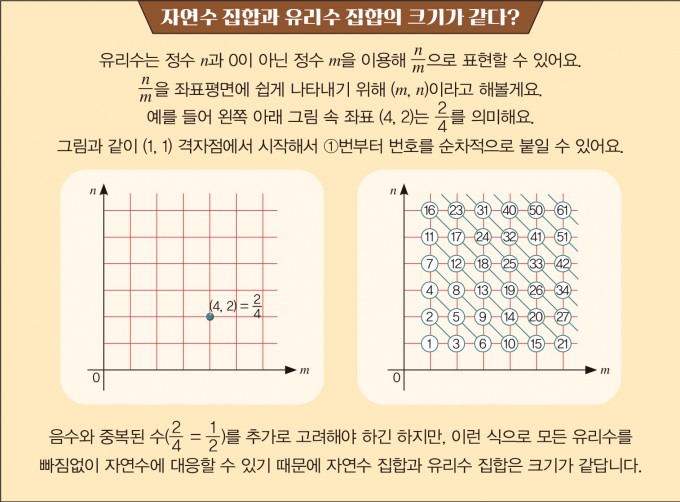
자연수 집합과 유리수 집합의 크기가 같다는 것도 비슷한 방식으로 보일 수 있어요. 그렇다면 모든 무한 집합은 크기가 모두 같을까요? 놀랍게도 독일 수학자 게오르크 칸토어(1845~1918)가 실수 집합은 자연수 집합보다 크다는 사실을 증명했어요. 더 작은 무한과 더 큰 무한이 존재한다는 거예요. 그리고 이런 무한의 크기조차도 무한하다는 게 현대 수학에서 이해하고 있는 무한입니다."


Q(인문학자). 수학자는 복잡한 무한을 어떻게 다루나요.


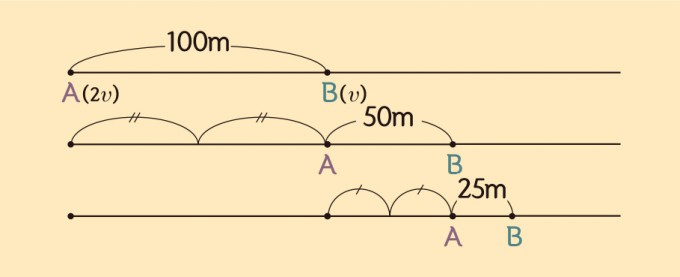
A(수학자). "예를 들어서 설명해볼게요. A는 자신보다 100m 앞서가는 B보다 2배 빠른 속도로 B를 따라잡으려고 해요. 그런데 A가 100m를 가는 동안 B는 다시 50m를 가고, 이어 A가 50m를 가는 동안 다시 B는 25m를 더 가지요. 이렇게 A가 B를 따라잡으려고 애써도, B 역시 계속 움직이므로 A는 영원히 B를 따라잡을 수 없는 것처럼 보입니다.


이것이 기원전 5세기에 나온 ‘제논의 역설’입니다. 현대수학을 이용해 이 논리가 틀림을 보일 수 있지만, 19세기 전 까지는 이를 깨트릴 방법이 없었습니다.


 수학동아 DB
수학동아 DB

앞서가는 사람이 처음의 절반을 가고 또 절반을 무한히 간다고 생각하면 끝이 없어 보이지만, 수로 나타내면 1/2+1/4+1/8+ …이에요. 이를 계산하면 1이라는 아주 간단한 수가 나오기 때문에 언젠가는 A가 B를 따라잡습니다. 이로써 인류는 무한한 덧셈을 걱정할 필요가 없습니다. 무한한 덧셈이라도 유한한 값으로 수렴하면 그 값을 그대로 이해하고 쓸 수 있으니까요. 


이렇듯 수학자는 무한급수를 이용해 무한을 다룹니다. 다른 예시를 하나 더 들어볼게요. 수학자가 하는 일 중 하나는 증명이잖아요. ‘1부터 n까지 자연수의 합은 언제나 n(n + 1)/2 이다' 라는 명제를 증명한다고 생각해보세요. 이 명제가 참이려면 n이 어떤 수이건 모두 참이어야 해요.


이러한 명제를 증명하는 방법 중 하나가 ‘수학적 귀납법’이 이에요. n = 1일 때 성립함을 보이고, n = k일 때 성립한다고 가정한 뒤 n = k + 1이 성립함을 보이면 어떤 무한한 계산이라도 참과 거짓을 증명할 수 있지요."


수학동아 DB
수학동아 DB


○ 세 번째 질문. 우리는 진정으로 무한을 아는가


Q(수학자) 지금까지 무한에 관한 수학 이야기를 했는데요. 교수님이 생각하시기에 우리는 진정 무한을 아는 걸까요.


A(인문학자) "무한을 어떤 방식으로 정의하는지에 따라서 답이 다를 것 같아요. 저도 무한을 처음 배울 때는 잘 못 받아들였어요. ‘왜 이걸 알아야 하지?’라고 생각한 적도 있고요. 그런데 수학사를 공부해 보니까 그게 비단 저만의 경험은 아니었더라고요.


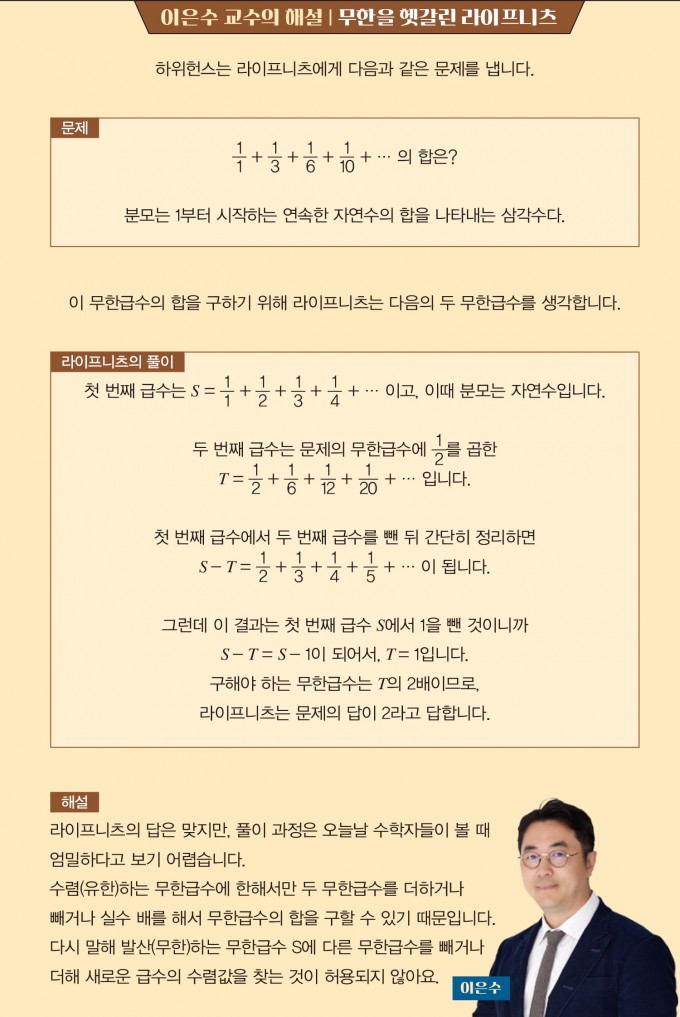
미적분학을 창시한 독일 수학자 고트프리트 라이프니츠 (1646~1716)조차 무한에 관해서 착각한 적이 있어요. 라이프니츠의 스승인 네덜란드 물리학자 크리스티안 하위헌스(1629~1695)는 라이프니츠를 시험해보려고 분모가 ‘삼각수’이고, 분자가 1인 유리수들의 무한급수가 수렴하는지를 묻는 문제를 냈어요.


라이프니츠의 풀이 과정을 보면 이 위대한 수학자조차도 유한과 무한을 혼동하고 있다는 사실을 알 수 있어요. 그런 걸 보면 무한을 이해하는 데까지 많은 시행착오를 겪어야 했네요."


수학자. 굉장히 좋은 말씀을 해주신 것 같아요. 앞서 제가 말했던 무한의 크기에 관한 이야기도 직관적이지는 않잖아요. 실제로 19세기 후반 칸토어가 처음 무한의 크기를 이야기했을 때 수학자들도 쉽게 받아들이지 못했어요.


20세기 초반 독일 수학자 다비트 힐베르트(1862~1943)와 영국 수학자 버트런드 러셀(1872~1970)에 의해 수리철학의 토대가 마련되면서 점차 무한을 받아들였지요.


수학자들 사이에서도 무한의 정의에 관해서는 아직도 의견이 분분해요. 예를 들면 ‘자연수 집합과 실수 집합의 중간 크기인 무한 집합이 있을까’ 같은 질문을 하지요.


‘연속체 가설’이라고 알려진 문제인데요. 근데 아주 신기하게도 ‘현재의 수학 체계에서는 이 명제가 참인지 거짓인지 증명할 수 없다’가 증명돼 있습니다. 증명할 수 없다는 게 증명됐다니 참 이상하지요. 어떻게 보면 우리가 무한에 여러가지 방법으로 접근하고 있지만, 무한은 아직도 아니 어쩌면 영원히 이해할 수 없지 않을까 생각합니다.

수학동아 DB
수학동아 

2023년 3월 25일 토요일

2023 AMC 8 Problems


Problem 1

What is the value of $(8 \times 4 + 2) - (8 + 4 \times 2)$?

$\textbf{(A)}\ 0 \qquad \textbf{(B)}\ 6 \qquad \textbf{(C)}\ 10 \qquad \textbf{(D)}\ 18 \qquad \textbf{(E)}\ 24$

Solution

Problem 2

A square piece of paper is folded twice into four equal quarters, as shown below, then cut along the dashed line. When unfolded, the paper will match which of the following figures?[asy]  //Restored original diagram. Alter it if you would like, but it was made by TheMathGuyd, // Diagram by TheMathGuyd. I even put the lined texture :) // Thank you Kante314 for inspiring thicker arrows. They do look much better size(0,3cm); path sq = (-0.5,-0.5)--(0.5,-0.5)--(0.5,0.5)--(-0.5,0.5)--cycle; path rh = (-0.125,-0.125)--(0.5,-0.5)--(0.5,0.5)--(-0.125,0.875)--cycle; path sqA = (-0.5,-0.5)--(-0.25,-0.5)--(0,-0.25)--(0.25,-0.5)--(0.5,-0.5)--(0.5,-0.25)--(0.25,0)--(0.5,0.25)--(0.5,0.5)--(0.25,0.5)--(0,0.25)--(-0.25,0.5)--(-0.5,0.5)--(-0.5,0.25)--(-0.25,0)--(-0.5,-0.25)--cycle; path sqB = (-0.5,-0.5)--(-0.25,-0.5)--(0,-0.25)--(0.25,-0.5)--(0.5,-0.5)--(0.5,0.5)--(0.25,0.5)--(0,0.25)--(-0.25,0.5)--(-0.5,0.5)--cycle; path sqC = (-0.25,-0.25)--(0.25,-0.25)--(0.25,0.25)--(-0.25,0.25)--cycle; path trD = (-0.25,0)--(0.25,0)--(0,0.25)--cycle; path sqE = (-0.25,0)--(0,-0.25)--(0.25,0)--(0,0.25)--cycle; filldraw(sq,mediumgrey,black); draw((0.75,0)--(1.25,0),currentpen+1,Arrow(size=6)); //folding path sqside = (-0.5,-0.5)--(0.5,-0.5); path rhside = (-0.125,-0.125)--(0.5,-0.5); transform fld = shift((1.75,0))*scale(0.5); draw(fld*sq,black); int i; for(i=0; i<10; i=i+1) {   draw(shift(0,0.05*i)*fld*sqside,deepblue); } path rhedge = (-0.125,-0.125)--(-0.125,0.8)--(-0.2,0.85)--cycle; filldraw(fld*rhedge,grey); path sqedge = (-0.5,-0.5)--(-0.5,0.4475)--(-0.575,0.45)--cycle; filldraw(fld*sqedge,grey); filldraw(fld*rh,white,black); int i; for(i=0; i<10; i=i+1) {   draw(shift(0,0.05*i)*fld*rhside,deepblue); } draw((2.25,0)--(2.75,0),currentpen+1,Arrow(size=6)); //cutting transform cut = shift((3.25,0))*scale(0.5); draw(shift((-0.01,+0.01))*cut*sq); draw(cut*sq); filldraw(shift((0.01,-0.01))*cut*sq,white,black); int j; for(j=0; j<10; j=j+1) { draw(shift(0,0.05*j)*cut*sqside,deepblue); } draw(shift((0.01,-0.01))*cut*(0,-0.5)--shift((0.01,-0.01))*cut*(0.5,0),dashed); //Answers Below, but already Separated //filldraw(sqA,grey,black); //filldraw(sqB,grey,black); //filldraw(sq,grey,black); //filldraw(sqC,white,black); //filldraw(sq,grey,black); //filldraw(trD,white,black); //filldraw(sq,grey,black); //filldraw(sqE,white,black); [/asy]

[asy] // Diagram by TheMathGuyd. size(0,7.5cm); path sq = (-0.5,-0.5)--(0.5,-0.5)--(0.5,0.5)--(-0.5,0.5)--cycle; path rh = (-0.125,-0.125)--(0.5,-0.5)--(0.5,0.5)--(-0.125,0.875)--cycle; path sqA = (-0.5,-0.5)--(-0.25,-0.5)--(0,-0.25)--(0.25,-0.5)--(0.5,-0.5)--(0.5,-0.25)--(0.25,0)--(0.5,0.25)--(0.5,0.5)--(0.25,0.5)--(0,0.25)--(-0.25,0.5)--(-0.5,0.5)--(-0.5,0.25)--(-0.25,0)--(-0.5,-0.25)--cycle; path sqB = (-0.5,-0.5)--(-0.25,-0.5)--(0,-0.25)--(0.25,-0.5)--(0.5,-0.5)--(0.5,0.5)--(0.25,0.5)--(0,0.25)--(-0.25,0.5)--(-0.5,0.5)--cycle; path sqC = (-0.25,-0.25)--(0.25,-0.25)--(0.25,0.25)--(-0.25,0.25)--cycle; path trD = (-0.25,0)--(0.25,0)--(0,0.25)--cycle; path sqE = (-0.25,0)--(0,-0.25)--(0.25,0)--(0,0.25)--cycle;  //ANSWERS real sh = 1.5; label("$\textbf{(A)}$",(-0.5,0.5),SW); label("$\textbf{(B)}$",shift((sh,0))*(-0.5,0.5),SW); label("$\textbf{(C)}$",shift((2sh,0))*(-0.5,0.5),SW); label("$\textbf{(D)}$",shift((0,-sh))*(-0.5,0.5),SW); label("$\textbf{(E)}$",shift((sh,-sh))*(-0.5,0.5),SW); filldraw(sqA,mediumgrey,black); filldraw(shift((sh,0))*sqB,mediumgrey,black); filldraw(shift((2*sh,0))*sq,mediumgrey,black); filldraw(shift((2*sh,0))*sqC,white,black); filldraw(shift((0,-sh))*sq,mediumgrey,black); filldraw(shift((0,-sh))*trD,white,black); filldraw(shift((sh,-sh))*sq,mediumgrey,black); filldraw(shift((sh,-sh))*sqE,white,black); [/asy]

Solution

Problem 3

Wind chill is a measure of how cold people feel when exposed to wind outside. A good estimate for wind chill can be found using this calculation\[(\text{wind chill}) = (\text{air temperature}) - 0.7 \times (\text{wind speed}),\]where temperature is measured in degrees Fahrenheit $(^{\circ}\text{F})$ and the wind speed is measured in miles per hour (mph). Suppose the air temperature is $36^{\circ}\text{F}$ and the wind speed is $18$ mph. Which of the following is closest to the approximate wind chill?

$\textbf{(A)}\ 18 \qquad \textbf{(B)}\ 23 \qquad \textbf{(C)}\ 28 \qquad \textbf{(D)}\ 32 \qquad \textbf{(E)}\ 35$

Solution

Problem 4

The numbers from $1$ to $49$ are arranged in a spiral pattern on a square grid, beginning at the center. The first few numbers have been entered into the grid below. Consider the four numbers that will appear in the shaded squares, on the same diagonal as the number $7.$ How many of these four numbers are prime?[asy] /* Made by MRENTHUSIASM */ size(175);  void ds(pair p) { 	filldraw((0.5,0.5)+p--(-0.5,0.5)+p--(-0.5,-0.5)+p--(0.5,-0.5)+p--cycle,mediumgrey); }  ds((0.5,4.5)); ds((1.5,3.5)); ds((3.5,1.5)); ds((4.5,0.5));  add(grid(7,7,grey+linewidth(1.25)));  int adj = 1; int curUp = 2; int curLeft = 4; int curDown = 6;  label("$1$",(3.5,3.5));  for (int len = 3; len<=3; len+=2) { 	for (int i=1; i<=len-1; ++i)     		{ 			label("$"+string(curUp)+"$",(3.5+adj,3.5-adj+i));     		label("$"+string(curLeft)+"$",(3.5+adj-i,3.5+adj));      		label("$"+string(curDown)+"$",(3.5-adj,3.5+adj-i));     		++curDown;     		++curLeft;     		++curUp; 		} 	++adj;     curUp = len^2 + 1;     curLeft = len^2 + len + 2;     curDown = len^2 + 2*len + 3; }  draw((4,4)--(3,4)--(3,3)--(5,3)--(5,5)--(2,5)--(2,2)--(6,2)--(6,6)--(1,6)--(1,1)--(7,1)--(7,7)--(0,7)--(0,0)--(7,0),linewidth(2)); [/asy]$\textbf{(A)}\ 0 \qquad \textbf{(B)}\ 1 \qquad \textbf{(C)}\ 2 \qquad \textbf{(D)}\ 3 \qquad \textbf{(E)}\ 4$

Solution

Problem 5

A lake contains $250$ trout, along with a variety of other fish. When a marine biologist catches and releases a sample of $180$ fish from the lake, $30$ are identified as trout. Assume that the ratio of trout to the total number of fish is the same in both the sample and the lake. How many fish are there in the lake?

$\textbf{(A)}\ 1250 \qquad \textbf{(B)}\ 1500 \qquad \textbf{(C)}\ 1750 \qquad \textbf{(D)}\ 1800 \qquad \textbf{(E)}\ 2000$

Solution

Problem 6

The digits $2, 0, 2,$ and $3$ are placed in the expression below, one digit per box. What is the maximum possible value of the expression?

[asy] // Diagram by TheMathGuyd. I can compress this later size(5cm); real w=2.2; pair O,I,J; O=(0,0);I=(1,0);J=(0,1); path bsqb = O--I; path bsqr = I--I+J; path bsqt = I+J--J; path bsql = J--O; path lsqb = shift((1.2,0.75))*scale(0.5)*bsqb; path lsqr = shift((1.2,0.75))*scale(0.5)*bsqr; path lsqt = shift((1.2,0.75))*scale(0.5)*bsqt; path lsql = shift((1.2,0.75))*scale(0.5)*bsql; draw(bsqb,dashed); draw(bsqr,dashed); draw(bsqt,dashed); draw(bsql,dashed); draw(lsqb,dashed); draw(lsqr,dashed); draw(lsqt,dashed); draw(lsql,dashed); label(scale(3)*"$\times$",(w,1/3)); draw(shift(1.3w,0)*bsqb,dashed); draw(shift(1.3w,0)*bsqr,dashed); draw(shift(1.3w,0)*bsqt,dashed); draw(shift(1.3w,0)*bsql,dashed); draw(shift(1.3w,0)*lsqb,dashed); draw(shift(1.3w,0)*lsqr,dashed); draw(shift(1.3w,0)*lsqt,dashed); draw(shift(1.3w,0)*lsql,dashed); [/asy]

$\textbf{(A)}\ 0 \qquad \textbf{(B)}\ 8 \qquad \textbf{(C)}\ 9 \qquad \textbf{(D)}\ 16 \qquad \textbf{(E)}\ 18$

Solution

Problem 7

A rectangle, with sides parallel to the $x$-axis and $y$-axis, has opposite vertices located at $(15, 3)$ and $(16, 5)$. A line drawn through points $A(0, 0)$ and $B(3, 1)$. Another line is drawn through points $C(0, 10)$ and $D(2, 9)$. How many points on the rectangle lie on at least one of the two lines?[asy] usepackage("mathptmx"); size(9cm); draw((0,-.5)--(0,11),EndArrow(size=.15cm)); draw((1,0)--(1,11),mediumgray); draw((2,0)--(2,11),mediumgray); draw((3,0)--(3,11),mediumgray); draw((4,0)--(4,11),mediumgray); draw((5,0)--(5,11),mediumgray); draw((6,0)--(6,11),mediumgray); draw((7,0)--(7,11),mediumgray); draw((8,0)--(8,11),mediumgray); draw((9,0)--(9,11),mediumgray); draw((10,0)--(10,11),mediumgray); draw((11,0)--(11,11),mediumgray); draw((12,0)--(12,11),mediumgray); draw((13,0)--(13,11),mediumgray); draw((14,0)--(14,11),mediumgray); draw((15,0)--(15,11),mediumgray); draw((16,0)--(16,11),mediumgray);  draw((-.5,0)--(17,0),EndArrow(size=.15cm)); draw((0,1)--(17,1),mediumgray); draw((0,2)--(17,2),mediumgray); draw((0,3)--(17,3),mediumgray); draw((0,4)--(17,4),mediumgray); draw((0,5)--(17,5),mediumgray); draw((0,6)--(17,6),mediumgray); draw((0,7)--(17,7),mediumgray); draw((0,8)--(17,8),mediumgray); draw((0,9)--(17,9),mediumgray); draw((0,10)--(17,10),mediumgray);  draw((-.13,1)--(.13,1)); draw((-.13,2)--(.13,2)); draw((-.13,3)--(.13,3)); draw((-.13,4)--(.13,4)); draw((-.13,5)--(.13,5)); draw((-.13,6)--(.13,6)); draw((-.13,7)--(.13,7)); draw((-.13,8)--(.13,8)); draw((-.13,9)--(.13,9)); draw((-.13,10)--(.13,10));  draw((1,-.13)--(1,.13)); draw((2,-.13)--(2,.13)); draw((3,-.13)--(3,.13)); draw((4,-.13)--(4,.13)); draw((5,-.13)--(5,.13)); draw((6,-.13)--(6,.13)); draw((7,-.13)--(7,.13)); draw((8,-.13)--(8,.13)); draw((9,-.13)--(9,.13)); draw((10,-.13)--(10,.13)); draw((11,-.13)--(11,.13)); draw((12,-.13)--(12,.13)); draw((13,-.13)--(13,.13)); draw((14,-.13)--(14,.13)); draw((15,-.13)--(15,.13)); draw((16,-.13)--(16,.13));  label(scale(.7)*"$1$", (1,-.13), S); label(scale(.7)*"$2$", (2,-.13), S); label(scale(.7)*"$3$", (3,-.13), S); label(scale(.7)*"$4$", (4,-.13), S); label(scale(.7)*"$5$", (5,-.13), S); label(scale(.7)*"$6$", (6,-.13), S); label(scale(.7)*"$7$", (7,-.13), S); label(scale(.7)*"$8$", (8,-.13), S); label(scale(.7)*"$9$", (9,-.13), S); label(scale(.7)*"$10$", (10,-.13), S); label(scale(.7)*"$11$", (11,-.13), S); label(scale(.7)*"$12$", (12,-.13), S); label(scale(.7)*"$13$", (13,-.13), S); label(scale(.7)*"$14$", (14,-.13), S); label(scale(.7)*"$15$", (15,-.13), S); label(scale(.7)*"$16$", (16,-.13), S);  label(scale(.7)*"$1$", (-.13,1), W); label(scale(.7)*"$2$", (-.13,2), W); label(scale(.7)*"$3$", (-.13,3), W); label(scale(.7)*"$4$", (-.13,4), W); label(scale(.7)*"$5$", (-.13,5), W); label(scale(.7)*"$6$", (-.13,6), W); label(scale(.7)*"$7$", (-.13,7), W); label(scale(.7)*"$8$", (-.13,8), W); label(scale(.7)*"$9$", (-.13,9), W); label(scale(.7)*"$10$", (-.13,10), W);   dot((0,0),linewidth(4)); label(scale(.75)*"$A$", (0,0), NE); dot((3,1),linewidth(4)); label(scale(.75)*"$B$", (3,1), NE);  dot((0,10),linewidth(4)); label(scale(.75)*"$C$", (0,10), NE); dot((2,9),linewidth(4)); label(scale(.75)*"$D$", (2,9), NE);  draw((15,3)--(16,3)--(16,5)--(15,5)--cycle,linewidth(1.125)); dot((15,3),linewidth(4)); dot((16,3),linewidth(4)); dot((16,5),linewidth(4)); dot((15,5),linewidth(4)); [/asy]$\textbf{(A)}\ 0 \qquad \textbf{(B)}\ 1 \qquad \textbf{(C)}\ 2 \qquad \textbf{(D)}\ 3 \qquad \textbf{(E)}\ 4$

Solution

Problem 8

Lola, Lolo, Tiya, and Tiyo participated in a ping pong tournament. Each player competed against each of the other three players exactly twice. Shown below are the win-loss records for the players. The numbers $1$ and $0$ represent a win or loss, respectively. For example, Lola won five matches and lost the fourth match. What was Tiyo’s win-loss record?

\[\begin{tabular}{c | c} Player & Result \\ \hline Lola & \texttt{111011}\\ Lolo & \texttt{101010}\\ Tiya & \texttt{010100}\\ Tiyo & \texttt{??????} \end{tabular}\]

$\textbf{(A)}\ \texttt{000101} \qquad \textbf{(B)}\ \texttt{001001} \qquad \textbf{(C)}\ \texttt{010000} \qquad \textbf{(D)}\ \texttt{010101} \qquad \textbf{(E)}\ \texttt{011000}$

Solution

Problem 9

Malaika is skiing on a mountain. The graph below shows her elevation, in meters, above the base of the mountain as she skis along a trail. In total, how many seconds does she spend at an elevation between $4$ and $7$ meters?[asy] // Diagram by TheMathGuyd. Found cubic, so graph is perfect. import graph; size(8cm); int i; for(i=1; i<9; i=i+1) { draw((-0.2,2i-1)--(16.2,2i-1), mediumgrey); draw((2i-1,-0.2)--(2i-1,16.2), mediumgrey); draw((-0.2,2i)--(16.2,2i), grey); draw((2i,-0.2)--(2i,16.2), grey); } Label f;  f.p=fontsize(6);  xaxis(-0.5,17.8,Ticks(f, 2.0),Arrow());  yaxis(-0.5,17.8,Ticks(f, 2.0),Arrow());  real f(real x)  {  return -0.03125 x^(3) + 0.75x^(2) - 5.125 x + 14.5;  }  draw(graph(f,0,15.225),currentpen+1); real dpt=2; real ts=0.75; transform st=scale(ts); label(rotate(90)*st*"Elevation (meters)",(-dpt,8)); label(st*"Time (seconds)",(8,-dpt)); [/asy]$\textbf{(A)}\ 6 \qquad \textbf{(B)}\ 8 \qquad \textbf{(C)}\ 10 \qquad \textbf{(D)}\ 12 \qquad \textbf{(E)}\ 14$

Solution

Problem 10

Harold made a plum pie to take on a picnic. He was able to eat only $\frac{1}{4}$ of the pie, and he left the rest for his friends. A moose came by and ate $\frac{1}{3}$ of what Harold left behind. After that, a porcupine ate $\frac{1}{3}$ of what the moose left behind. How much of the original pie still remained after the porcupine left?

$\textbf{(A)}\ \frac{1}{12} \qquad \textbf{(B)}\ \frac{1}{6} \qquad \textbf{(C)}\ \frac{1}{4} \qquad \textbf{(D)}\ \frac{1}{3} \qquad \textbf{(E)}\ \frac{5}{12}$

Solution

Problem 11

NASA’s Perseverance Rover was launched on July $30,$ $2020.$ After traveling $292{,}526{,}838$ miles, it landed on Mars in Jezero Crater about $6.5$ months later. Which of the following is closest to the Rover’s average interplanetary speed in miles per hour?

$\textbf{(A)}\ 6{,}000 \qquad \textbf{(B)}\ 12{,}000 \qquad \textbf{(C)}\ 60{,}000 \qquad \textbf{(D)}\ 120{,}000 \qquad \textbf{(E)}\ 600{,}000$

Solution

Problem 12

The figure below shows a large white circle with a number of smaller white and shaded circles in its interior. What fraction of the interior of the large white circle is shaded?

[asy] // Diagram by TheMathGuyd size(6cm); draw(circle((3,3),3)); filldraw(circle((2,3),2),lightgrey); filldraw(circle((3,3),1),white); filldraw(circle((1,3),1),white); filldraw(circle((5.5,3),0.5),lightgrey); filldraw(circle((4.5,4.5),0.5),lightgrey); filldraw(circle((4.5,1.5),0.5),lightgrey); int i, j; for(i=0; i<7; i=i+1) { draw((0,i)--(6,i), dashed+grey); draw((i,0)--(i,6), dashed+grey); } [/asy]

$\textbf{(A)}\ \frac{1}{4} \qquad \textbf{(B)}\ \frac{11}{36} \qquad \textbf{(C)}\ \frac{1}{3} \qquad \textbf{(D)}\ \frac{19}{36} \qquad \textbf{(E)}\ \frac{5}{9}$


Solution

Problem 13

Along the route of a bicycle race, $7$ water stations are evenly spaced between the start and finish lines, as shown in the figure below. There are also $2$ repair stations evenly spaced between the start and finish lines. The $3$rd water station is located $2$ miles after the $1$st repair station. How long is the race in miles?[asy] // Credits given to Themathguyd‎ and Kante314 usepackage("mathptmx"); size(10cm); filldraw((11,4.5)--(171,4.5)--(171,17.5)--(11,17.5)--cycle,mediumgray*0.4 + lightgray*0.6); draw((11,11)--(171,11),linetype("2 2")+white+linewidth(1.2)); draw((0,0)--(11,0)--(11,22)--(0,22)--cycle); draw((171,0)--(182,0)--(182,22)--(171,22)--cycle);  draw((31,4.5)--(31,0)); draw((51,4.5)--(51,0)); draw((151,4.5)--(151,0));  label(scale(.85)*rotate(45)*"Water 1", (23,-13.5)); label(scale(.85)*rotate(45)*"Water 2", (43,-13.5)); label(scale(.85)*rotate(45)*"Water 7", (143,-13.5));  filldraw(circle((103,-13.5),.2)); filldraw(circle((98,-13.5),.2)); filldraw(circle((93,-13.5),.2)); filldraw(circle((88,-13.5),.2)); filldraw(circle((83,-13.5),.2));  label(scale(.85)*rotate(90)*"Start", (5.5,11)); label(scale(.85)*rotate(270)*"Finish", (176.5,11)); [/asy]$\textbf{(A)}\ 8 \qquad \textbf{(B)}\ 16 \qquad \textbf{(C)}\ 24 \qquad \textbf{(D)}\ 48 \qquad \textbf{(E)}\ 96$

Solution

Problem 14

Nicolas is planning to send a package to his friend Anton, who is a stamp collector. To pay for the postage, Nicolas would like to cover the package with a large number of stamps. Suppose he has a collection of $5$-cent, $10$-cent, and $25$-cent stamps, with exactly $20$ of each type. What is the greatest number of stamps Nicolas can use to make exactly $$7.10$ in postage? (Note: The amount $$7.10$ corresponds to $7$ dollars and $10$ cents. One dollar is worth $100$ cents.)

$\textbf{(A)}\ 45 \qquad \textbf{(B)}\ 46 \qquad \textbf{(C)}\ 51 \qquad \textbf{(D)}\ 54\qquad \textbf{(E)}\ 55$

Solution

Problem 15

Viswam walks half a mile to get to school each day. His route consists of $10$ city blocks of equal length and he takes $1$ minute to walk each block. Today, after walking $5$ blocks, Viswam discovers he has to make a detour, walking $3$ blocks of equal length instead of $1$ block to reach the next corner. From the time he starts his detour, at what speed, in mph, must he walk, in order to get to school at his usual time?[asy] // Diagram by TheMathGuyd size(13cm); // this is an important stickman to the left of the origin pair C=midpoint((-0.5,0.5)--(-0.6,0.05)); draw((-0.5,0.5)--(-0.6,0.05)); // Head to butt draw((-0.64,0.16)--(-0.7,0.2)--C--(-0.47,0.2)--(-0.4,0.22)); // LH-C-RH draw((-0.6,0.05)--(-0.55,-0.1)--(-0.57,-0.25)); draw((-0.6,0.05)--(-0.68,-0.12)--(-0.8,-0.20));  filldraw(circle((-0.5,0.5),0.1),white,black);  int i; real d,s; // gap and side d=0.2; s=1-2*d; for(i=0; i<10; i=i+1) {   //dot((i,0), red); //marks to start   filldraw((i+d,d)--(i+1-d,d)--(i+1-d,1-d)--(i+d,1-d)--cycle, lightgrey, black);   filldraw(conj((i+d,d))--conj((i+1-d,d))--conj((i+1-d,1-d))--conj((i+d,1-d))--cycle,lightgrey,black); }  fill((5+d,-d/2)--(6-d,-d/2)--(6-d,d/2)--(5+d,d/2)--cycle,lightred);  draw((0,0)--(5,0)--(5,1)--(6,1)--(6,0)--(10.1,0),deepblue+linewidth(1.25)); //Who even noticed label("School", (10,0),E, Draw()); [/asy]$\textbf{(A)}\ 4 \qquad \textbf{(B)}\ 4.2 \qquad \textbf{(C)}\ 4.5 \qquad \textbf{(D)}\ 4.8 \qquad \textbf{(E)}\ 5$

Solution

Problem 16

The letters $\text{P}, \text{Q},$ and $\text{R}$ are entered into a $20\times20$ table according to the pattern shown below. How many $\text{P}$s, $\text{Q}$s, and $\text{R}$s will appear in the completed table?[asy] /* Made by MRENTHUSIASM, Edited by Kante314 */ usepackage("mathdots"); size(5cm); draw((0,0)--(6,0),linewidth(1.5)+mediumgray); draw((0,1)--(6,1),linewidth(1.5)+mediumgray); draw((0,2)--(6,2),linewidth(1.5)+mediumgray); draw((0,3)--(6,3),linewidth(1.5)+mediumgray); draw((0,4)--(6,4),linewidth(1.5)+mediumgray); draw((0,5)--(6,5),linewidth(1.5)+mediumgray);  draw((0,0)--(0,6),linewidth(1.5)+mediumgray); draw((1,0)--(1,6),linewidth(1.5)+mediumgray); draw((2,0)--(2,6),linewidth(1.5)+mediumgray); draw((3,0)--(3,6),linewidth(1.5)+mediumgray); draw((4,0)--(4,6),linewidth(1.5)+mediumgray); draw((5,0)--(5,6),linewidth(1.5)+mediumgray);  label(scale(.9)*"\textsf{P}", (.5,.5)); label(scale(.9)*"\textsf{Q}", (.5,1.5)); label(scale(.9)*"\textsf{R}", (.5,2.5)); label(scale(.9)*"\textsf{P}", (.5,3.5)); label(scale(.9)*"\textsf{Q}", (.5,4.5)); label("$\vdots$", (.5,5.6));  label(scale(.9)*"\textsf{Q}", (1.5,.5)); label(scale(.9)*"\textsf{R}", (1.5,1.5)); label(scale(.9)*"\textsf{P}", (1.5,2.5)); label(scale(.9)*"\textsf{Q}", (1.5,3.5)); label(scale(.9)*"\textsf{R}", (1.5,4.5)); label("$\vdots$", (1.5,5.6));  label(scale(.9)*"\textsf{R}", (2.5,.5)); label(scale(.9)*"\textsf{P}", (2.5,1.5)); label(scale(.9)*"\textsf{Q}", (2.5,2.5)); label(scale(.9)*"\textsf{R}", (2.5,3.5)); label(scale(.9)*"\textsf{P}", (2.5,4.5)); label("$\vdots$", (2.5,5.6));  label(scale(.9)*"\textsf{P}", (3.5,.5)); label(scale(.9)*"\textsf{Q}", (3.5,1.5)); label(scale(.9)*"\textsf{R}", (3.5,2.5)); label(scale(.9)*"\textsf{P}", (3.5,3.5)); label(scale(.9)*"\textsf{Q}", (3.5,4.5)); label("$\vdots$", (3.5,5.6));  label(scale(.9)*"\textsf{Q}", (4.5,.5)); label(scale(.9)*"\textsf{R}", (4.5,1.5)); label(scale(.9)*"\textsf{P}", (4.5,2.5)); label(scale(.9)*"\textsf{Q}", (4.5,3.5)); label(scale(.9)*"\textsf{R}", (4.5,4.5)); label("$\vdots$", (4.5,5.6));  label(scale(.9)*"$\dots$", (5.5,.5)); label(scale(.9)*"$\dots$", (5.5,1.5)); label(scale(.9)*"$\dots$", (5.5,2.5)); label(scale(.9)*"$\dots$", (5.5,3.5)); label(scale(.9)*"$\dots$", (5.5,4.5)); label(scale(.9)*"$\iddots$", (5.5,5.6)); [/asy]$\textbf{(A)}~132\text{ Ps, }134\text{ Qs, }134\text{ Rs}$

$\textbf{(B)}~133\text{ Ps, }133\text{ Qs, }134\text{ Rs}$

$\textbf{(C)}~133\text{ Ps, }134\text{ Qs, }133\text{ Rs}$

$\textbf{(D)}~134\text{ Ps, }132\text{ Qs, }134\text{ Rs}$

$\textbf{(E)}~134\text{ Ps, }133\text{ Qs, }133\text{ Rs}$

Solution

Problem 17

A regular octahedron has eight equilateral triangle faces with four faces meeting at each vertex. Jun will make the regular octahedron shown on the right by folding the piece of paper shown on the left. Which numbered face will end up to the right of $Q$?

[asy] // Diagram by TheMathGuyd import graph; // The Solid // To save processing time, do not use three (dimensions) // Project (roughly) to two size(15cm); pair Fr, Lf, Rt, Tp, Bt, Bk; Lf=(0,0); Rt=(12,1); Fr=(7,-1); Bk=(5,2); Tp=(6,6.7); Bt=(6,-5.2); draw(Lf--Fr--Rt); draw(Lf--Tp--Rt); draw(Lf--Bt--Rt); draw(Tp--Fr--Bt); draw(Lf--Bk--Rt,dashed); draw(Tp--Bk--Bt,dashed); label(rotate(-8.13010235)*slant(0.1)*"$Q$", (4.2,1.6)); label(rotate(21.8014095)*slant(-0.2)*"$?$", (8.5,2.05)); pair g = (-8,0); // Define Gap transform real a = 8; draw(g+(-a/2,1)--g+(a/2,1), Arrow()); // Make arrow // Time for the NET pair DA,DB,DC,CD,O; DA = (4*sqrt(3),0); DB = (2*sqrt(3),6); DC = (DA+DB)/3; CD = conj(DC); O=(0,0); transform trf=shift(3g+(0,3)); path NET = O--(-2*DA)--(-2DB)--(-DB)--(2DA-DB)--DB--O--DA--(DA-DB)--O--(-DB)--(-DA)--(-DA-DB)--(-DB); draw(trf*NET); label("$7$",trf*DC); label("$Q$",trf*DC+DA-DB); label("$5$",trf*DC-DB); label("$3$",trf*DC-DA-DB); label("$6$",trf*CD); label("$4$",trf*CD-DA); label("$2$",trf*CD-DA-DB); label("$1$",trf*CD-2DA); [/asy]

$\textbf{(A)}\ 1 \qquad \textbf{(B)}\ 2 \qquad \textbf{(C)}\ 3 \qquad \textbf{(D)}\ 4 \qquad \textbf{(E)}\ 5$

Solution

Problem 18

Greta Grasshopper sits on a long line of lily pads in a pond. From any lily pad, Greta can jump $5$ pads to the right or $3$ pads to the left. What is the fewest number of jumps Greta must make to reach the lily pad located $2023$ pads to the right of her starting point?

$\textbf{(A)}\ 405 \qquad \textbf{(B)}\ 407 \qquad \textbf{(C)}\ 409 \qquad \textbf{(D)}\ 411 \qquad \textbf{(E)}\ 413$

Solution

Problem 19

An equilateral triangle is placed inside a larger equilateral triangle so that the region between them can be divided into three congruent trapezoids, as shown below. The side length of the inner triangle is $\frac23$ the side length of the larger triangle. What is the ratio of the area of one trapezoid to the area of the inner triangle?

[asy] // Diagram by TheMathGuyd  pair A,B,C; A=(0,1); B=(sqrt(3)/2,-1/2); C=-conj(B); fill(2B--3B--3C--2C--cycle,grey); dot(3A); dot(3B); dot(3C); dot(2A); dot(2B); dot(2C); draw(2A--2B--2C--cycle); draw(3A--3B--3C--cycle); draw(2A--3A); draw(2B--3B); draw(2C--3C); [/asy]

$\textbf{(A) } 1 : 3 \qquad \textbf{(B) } 3 : 8 \qquad \textbf{(C) } 5 : 12 \qquad \textbf{(D) } 7 : 16 \qquad \textbf{(E) } 4 : 9$

Solution

Problem 20

Two integers are inserted into the list $3,3,8,11,28$ to double its range. The mode and median remain unchanged. What is the maximum possible sum of two additional numbers?

$\textbf{(A)}\ 56 \qquad \textbf{(B)}\ 57 \qquad \textbf{(C)}\ 58 \qquad \textbf{(D)}\ 60 \qquad \textbf{(E)}\ 61$

Solution

Problem 21

Alina writes the numbers $1, 2, \dots , 9$ on separate cards, one number per card. She wishes to divide the cards into $3$ groups of $3$ cards so that the sum of the numbers in each group will be the same. In how many ways can this be done?

$\textbf{(A)}\ 0 \qquad \textbf{(B)}\ 1 \qquad \textbf{(C)}\ 2 \qquad \textbf{(D)}\ 3 \qquad \textbf{(E)}\ 4$

Solution

Problem 22

In a sequence of positive integers, each term after the second is the product of the previous two terms. The sixth term is $4000$. What is the first term?

$\textbf{(A)}\ 1 \qquad \textbf{(B)}\ 2 \qquad \textbf{(C)}\ 4 \qquad \textbf{(D)}\ 5 \qquad \textbf{(E)}\ 10$

Solution

Problem 23

Each square in a $3 \times 3$ grid is randomly filled with one of the $4$ gray and white tiles shown below on the right.[asy] size(5.663333333cm); draw((0,0)--(3,0)--(3,3)--(0,3)--cycle,gray); draw((1,0)--(1,3)--(2,3)--(2,0),gray); draw((0,1)--(3,1)--(3,2)--(0,2),gray);  fill((6,.33)--(7,.33)--(7,1.33)--cycle,mediumgray); draw((6,.33)--(7,.33)--(7,1.33)--(6,1.33)--cycle,gray); fill((6,1.67)--(7,2.67)--(6,2.67)--cycle,mediumgray); draw((6,1.67)--(7,1.67)--(7,2.67)--(6,2.67)--cycle,gray); fill((7.33,.33)--(8.33,.33)--(7.33,1.33)--cycle,mediumgray); draw((7.33,.33)--(8.33,.33)--(8.33,1.33)--(7.33,1.33)--cycle,gray); fill((8.33,1.67)--(8.33,2.67)--(7.33,2.67)--cycle,mediumgray); draw((7.33,1.67)--(8.33,1.67)--(8.33,2.67)--(7.33,2.67)--cycle,gray); [/asy]What is the probability that the tiling will contain a large gray diamond in one of the smaller $2 \times 2$ grids? Below is an example of such tiling.[asy] size(2cm);  fill((1,0)--(0,1)--(0,2)--(1,1)--cycle,mediumgray); fill((2,0)--(3,1)--(2,2)--(1,1)--cycle,mediumgray); fill((1,2)--(1,3)--(0,3)--cycle,mediumgray); fill((1,2)--(2,2)--(2,3)--cycle,mediumgray); fill((3,2)--(3,3)--(2,3)--cycle,mediumgray);  draw((0,0)--(3,0)--(3,3)--(0,3)--cycle,gray); draw((1,0)--(1,3)--(2,3)--(2,0),gray); draw((0,1)--(3,1)--(3,2)--(0,2),gray); [/asy]

$\textbf{(A) } \frac{1}{1024} \qquad \textbf{(B) } \frac{1}{256} \qquad \textbf{(C) } \frac{1}{64} \qquad \textbf{(D) } \frac{1}{16} \qquad \textbf{(E) } \frac{1}{4}$

Solution

Problem 24

Isosceles triangle $ABC$ has equal side lengths $AB$ and $BC$. In the figures below, segments are drawn parallel to $\overline{AC}$ so that the shaded portions of $\triangle ABC$ have the same area. The heights of the two unshaded portions are 11 and 5 units, respectively. What is the height $h$ of $\triangle ABC$?

[asy] //Diagram by TheMathGuyd size(12cm); real h = 2.5; // height real g=4; //c2c space real s = 0.65; //Xcord of Hline real adj = 0.08; //adjust line diffs pair A,B,C; B=(0,h); C=(1,0); A=-conj(C); pair PONE=(s,h*(1-s)); //Endpoint of Hline ONE pair PTWO=(s+adj,h*(1-s-adj)); //Endpoint of Hline ONE path LONE=PONE--(-conj(PONE)); //Hline ONE path LTWO=PTWO--(-conj(PTWO)); path T=A--B--C--cycle; //Triangle   fill (shift(g,0)*(LTWO--B--cycle),mediumgrey); fill (LONE--A--C--cycle,mediumgrey);  draw(LONE); draw(T); label("$A$",A,SW); label("$B$",B,N); label("$C$",C,SE);  draw(shift(g,0)*LTWO); draw(shift(g,0)*T); label("$A$",shift(g,0)*A,SW); label("$B$",shift(g,0)*B,N); label("$C$",shift(g,0)*C,SE);  draw(B--shift(g,0)*B,dashed); draw(C--shift(g,0)*A,dashed); draw((g/2,0)--(g/2,h),dashed); draw((0,h*(1-s))--B,dashed); draw((g,h*(1-s-adj))--(g,0),dashed); label("$5$", midpoint((g,h*(1-s-adj))--(g,0)),UnFill); label("$h$", midpoint((g/2,0)--(g/2,h)),UnFill); label("$11$", midpoint((0,h*(1-s))--B),UnFill); [/asy]

$\textbf{(A)}\ 14.6 \qquad \textbf{(B)}\ 14.8 \qquad \textbf{(C)}\ 15 \qquad \textbf{(D)}\ 15.2 \qquad \textbf{(E)}\ 15.4$

Solution

Problem 25

Fifteen integers $a_1, a_2, a_3, \dots, a_{15}$ are arranged in order on a number line. The integers are equally spaced and have the property that\[1 \le a_1 \le 10, \thickspace 13 \le a_2 \le 20, \thickspace \text{ and } \thickspace 241 \le a_{15}\le 250.\]What is the sum of digits of $a_{14}?$

$\textbf{(A)}\ 8 \qquad \textbf{(B)}\ 9 \qquad \textbf{(C)}\ 10 \qquad \textbf{(D)}\ 11 \qquad \textbf{(E)}\ 12$

Solution